UPSC Marks Calculator: Calculate Your Prelims Score with Accuracy (GS + CSAT)
What is the UPSC Marks Calculator?
This UPSC Marks Calculator is a simple tool built for people prepping for the Civil Services Preliminary Exam. In the UPSC CSE, every point matters because it decides if you move on or wait another year. This calculator gets rid of the work and mistakes that come with figuring out your score after the answer key is released. It’s made to understand the details of both General Studies Paper-I and CSAT Paper-II, including the official negative marking rules from the Union Public Service Commission. Use it to check your scores on practice tests or guess your final Prelims score. It gives you a quick, correct report of your right answers, wrong answer penalties, and total score. By doing the calculations for you, this lets you concentrate on what’s important: seeing what you did well or badly and planning how to study for the Mains exam.
How UPSC Prelims Marks Are Calculated?
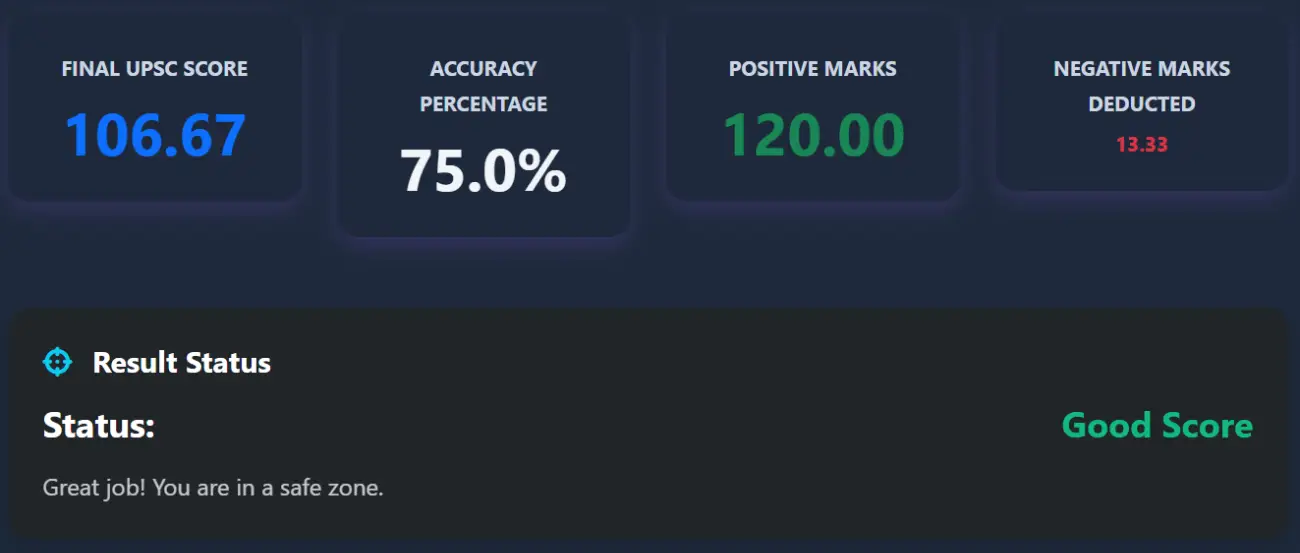
Understanding the arithmetic behind UPSC scoring is vital. The Preliminary exam consists of two objective-type papers. Use the following breakdown to understand the logic: For GS Paper-I: This paper contains 100 questions, each carrying 2 marks, for a total of 200 marks. The negative marking is one-third (1/3rd) of the marks assigned to the question. - Correct Answer: +2 Marks - Incorrect Answer: -0.66 Marks (2 * 1/3) - Unattempted: 0 Marks For CSAT Paper-II: This paper contains 80 questions, totaling 200 marks. Each question carries 2.5 marks. - Correct Answer: +2.5 Marks - Incorrect Answer: -0.83 Marks (2.5 * 1/3) - Unattempted: 0 Marks The Final Formula: Net Score = (Total Correct Answers × Marks per Question) - (Total Wrong Answers × Penalty per Wrong Answer). For example, if you attempt 80 questions in GS, get 60 correct and 20 wrong: Positive Score = 60 * 2 = 120 Negative Penalty = 20 * 0.66 = 13.2 Final Score = 120 - 13.2 = 106.8. This calculator performs these operations instantly.
How to Use This UPSC Score Calculator?
- Select Exam Paper: Choose between 'GS Paper-I' (for merit) or 'CSAT Paper-II' (for qualifying status).

- Input Total Attempts: Enter the total number of questions you bubbled in the OMR sheet.

- Input Wrong Answers: Compare with the official answer key and enter the count of incorrect responses.

- Analyze Results: Hit 'Calculate Score' to view your Net Score, Accuracy %, and a detailed dashboard of your performance status.
Deep Dive: UPSC Negative Marking Rules Explained
The concept of negative marking is the biggest hurdle in the Prelims. UPSC imposes a penalty of 1/3rd marks for every wrong answer. This rule is designed to discourage random guessing and reward precision. Statistically, this means that for every three wrong answers, you neutralize the gain of one correct answer. For instance, in GS Paper 1: If you mark 4 questions: - Scenario A: 4 Correct (Score: 8 Marks) - Scenario B: 3 Correct, 1 Wrong (Score: 6 - 0.66 = 5.34 Marks) - Scenario C: 1 Correct, 3 Wrong (Score: 2 - 1.98 = 0.02 Marks!) As you can see in Scenario C, getting 3 wrong almost wipes out the credit for 1 right answer. This "Penalty Trap" is why high attempts with low accuracy are often suicidal in UPSC Prelims. Aspirants must carefully weigh the risk-reward ratio before marking an answer they are unsure about.
Why Accuracy Matters More Than Attempts?
A common myth among aspirants is that attempting 90+ questions is mandatory to clear the cutoff. While high attempts can help, they are counterproductive without accuracy. Let's analyze two candidates: Candidate A (The Aggressor): Attempts: 95 Correct: 60 Wrong: 35 Score = (60 * 2) - (35 * 0.66) = 120 - 23.1 = 96.9 Marks. Candidate B (The Strategist): Attempts: 80 Correct: 58 Wrong: 22 Score = (58 * 2) - (22 * 0.66) = 116 - 14.52 = 101.48 Marks. Candidate B, despite attempting 15 fewer questions and having fewer correct answers than A, scores higher because they minimized their negative penalty. Your strategy should focus on maximizing 'Sure-Shot' answers and taking calculated risks only where you can eliminate at least two options. This calculator helps you realize your 'Accuracy Sweet Spot' by showing you exactly how much your negative marks are dragging down your total.
Common Mistakes to Avoid in Calculation
When calculating scores manually, aspirants often make these errors: 1. Ignoring the 'Unattempted' Buffer: Sometimes students forget that unattempted questions attract zero penalty. They mistakenly count them as wrong. 2. Wrong Penalty Value: Using 0.33 instead of 0.66. Remember, the penalty is 1/3rd of the *question's marks* (2 or 2.5), not 1/3rd of 100. 3. CSAT Miscalculation: Applying GS rules to CSAT. In CSAT, the penalty is higher (0.833) because the per-question weightage is higher (2.5). 4. Answer Key Variations: Relying on a single coaching institute's key. It is advisable to average scores from 2-3 reliable keys or wait for the official UPSC key for the true picture. Using our automated tool removes the first three errors entirely, ensuring you get a mathematically precise figure every time.
GS Paper-I vs. CSAT Paper-II: The Critical Difference
It is crucial to treat the two papers differently. GS Paper-I determines your merit. This score is what counts for the cutoff (usually ranging between 85-100 marks depending on difficulty). Every mark here pushes you closer to the Mains list. CSAT Paper-II is qualifying. You do not need to top this paper; you only need to cross the threshold of 33% (approx 66.67 marks). Scoring 150 in CSAT is of no extra value if you score 200. However, failing CSAT (scoring below 66) disqualifies you instantly, even if you score 120+ in GS. Use this calculator for both. For GS, aim for maximization. For CSAT, check if you are comfortably above the danger line (aim for 80+ to be safe from answer key discrepancies).
Tips to Minimize Negative Marking
1. The 50-50 Rule: If you can eliminate 2 options, attempted the question. Probability favors you scoring positive in the long run. 2. Avoid Wild Guessing: If you have no clue about any option, skip it. The 0.66 penalty will hurt more than the potential 2 marks gain. 3. Read the Question Carefully: UPSC often tricks aspirants with words like 'Incorrect', 'Not', 'Only'. Misreading leads to 'silly mistakes' which are the most painful form of negative marking. 4. Round-Wise Attempt: Solve the paper in 3 rounds. round 1 for 100% sure answers, Round 2 for 50-50 logic, Round 3 for high-risk gambles (only if attempts are too low). 5. Review with this Tool: After every mock test, input your data here. If your negative markings incorrectly exceed 15-20% of your total marks, you need to refine your guessing strategy.
Understanding Suggested Cut-offs
The Result Status in this calculator looks at past trends. Usually, getting over 100 in GS Paper-I is seen as a good spot for those in the General Category. But, the actual cutoff scores can change a lot depending on how hard the paper is. For example, in 2023, the cutoff went down to around 75. So, think of your score here as a way to see where you are in your studying, not as a final answer. If you're getting 10 or more marks above last year's cutoff in your practice tests, you're probably doing well.
Conclusion
Getting into LBSNAA starts with passing the prelims. The UPSC Marks Calculator can help you during this stage. It brings clarity when you're dealing with answer keys and figuring out your score. It gives you good info about your attempts, how accurate you are, and negative marks. This lets you make smart choices about how you study. Save this tool and use it after each practice test to see how you are doing. Keep in mind that being consistent and accurate are very important. Good luck with your studying!
Frequently Asked Questions
What is the UPSC Marks Calculator?
It is a digital tool that helps UPSC aspirants calculate their estimated score for Prelims by automatically applying the negative marking logic.
How is the UPSC Prelims score calculated?
It is calculated by subtracting penalty marks from positive marks. Formula: (Correct × Marks/Q) - (Wrong × 1/3rd of Marks/Q).
Does UPSC have negative marking?
Yes, UPSC Prelims has a negative marking of 1/3rd (33%) for every incorrect answer in both GS and CSAT papers.
Is CSAT qualifying only?
Yes, CSAT (Paper-II) is qualifying. You need to score at least 33% (approx 66 marks) to qualify for marks calculation of GS Paper-I.
Is this UPSC Marks Calculator accurate?
Yes, this calculator uses the exact marking scheme provided by UPSC. However, final results depend on the official UPSC answer key.