SSC Marks Calculator: The Ultimate Guide to Calculating Your Score (CGL, CHSL, MTS, GD)
What is the SSC Marks Calculator?
The SSC Marks Calculator is a helpful tool made for people taking Staff Selection Commission (SSC) tests. If you're aiming for the CGL, CHSL, MTS, or even the SSC GD Constable and CPO exams, this calculator can be your go-to digital helper. In the tough world of government exams, where even tiny score differences matter, knowing your exact score is super important. This calculator gets rid of mistakes that can happen when you do things by hand. It uses the right negative marking rules (like 1/4th or 1/3rd) for your specific exam, so you can quickly see your correct score, any points taken off, and your final raw score.
Understanding the Math: How SSC Calculates Your Marks
The scoring logic of the Staff Selection Commission is transparent but strict. It revolves around two main components: Rewards for Accuracy and Penalties for Errors. For most SSC Tier-1 exams (CGL, CHSL): - Each correct answer awards you +2 Marks. - Each incorrect answer deducts 0.50 Marks. - This creates a negative marking ratio of 0.25 (or 25%), meaning one wrong answer consumes the marks of a quarter of a correct answer. For exams like SSC MTS (New Pattern): - In Session 2 (General Awareness & English), correct answers give +3 Marks. - Incorrect answers deduct -1 Mark. - This is a steeper 33.33% penalty, making accuracy even more critical. The Formula: Your Raw Score is calculated as: (Total Correct × Marks per Q) - (Total Wrong × Penalty per Q). Our calculator acts as an automated engine for this formula, ensuring that regardless of the exam pattern, your score is derived with mathematical certainty.
SSC Raw Score = (Correct Answers × Marks per Question) - (Wrong Answers × Negative Marking Penalty)
Step-by-Step Guide to Using This Tool
- Choose Your Exam: Select SSC CGL, CHSL, MTS, or GD from the dropdown. The tool automatically adjusts total questions and max marks.
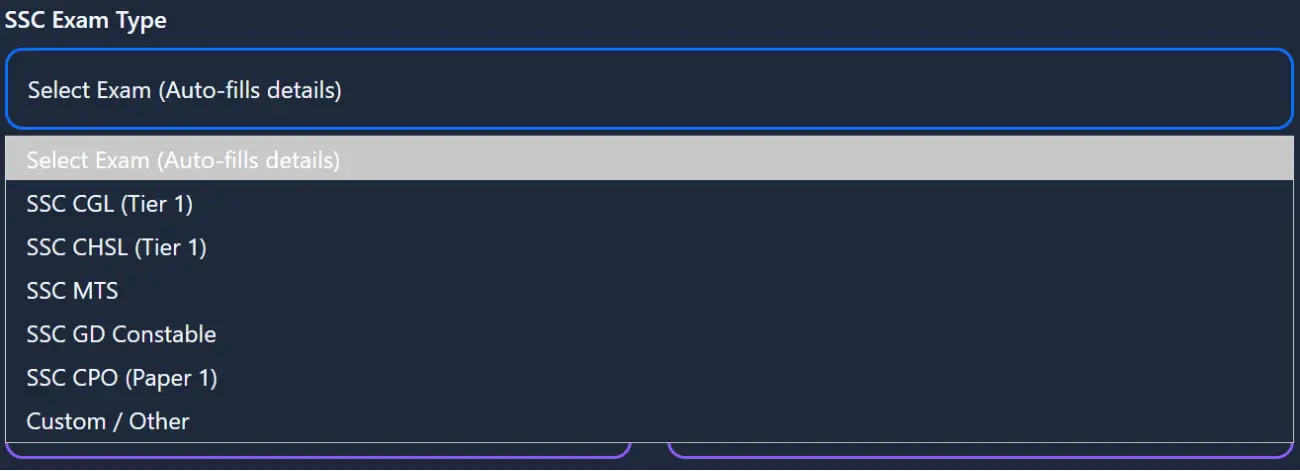
- Input Your Data: Enter the number of questions you marked in the exam. Be honest with the 'Wrong Answers' count based on the answer key.

- Set Negative Marking: If your exam shift had a special penalty rule, use the dropdown to customize the ratio (e.g., 1/3 instead of 1/4).
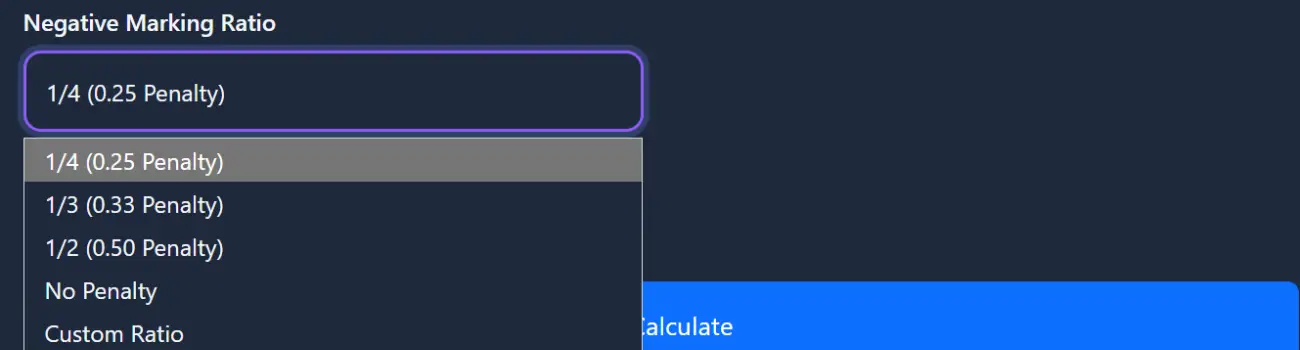
- Analyze Performance: Click 'Calculate'. The dashboard will reveal not just your score, but your accuracy percentage and simple 'Safe/Unsafe' zone indicators.
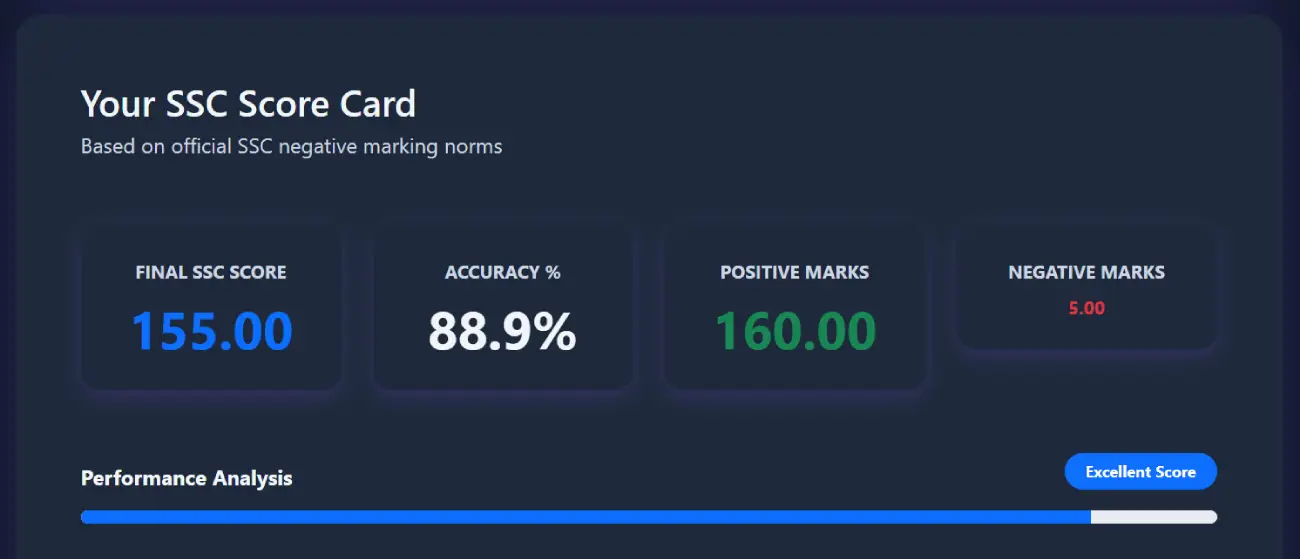
Benefits of Using SSC Marks Calculator
- Time Saving: Instantly calculate scores without manual math.
- Accuracy Check: Know your accuracy percentage to improve in mocks.
- Strategy Planning: Understand how many questions you can afford to skip or risk.
- Normalization Readiness: Knowing your raw score helps you estimate your normalized score using past trends.
- Exam Specific: Tailored presets for CGL, CHSL, MTS, and GD save you time.
- Risk Analysis: See exactly how much negative marking is eating into your profits.
- Goal Setting: Set a target cutoff and see if you are clearing it.
- Easy Reset: Quickly switch between different mock test results.
- Mobile Friendly: Check your scores on the go after an exam center.
- Free to Use: Unlimited calculations for all your practice sets.
Raw Score vs. Normalized Score: The confusion
The score this calculator gives you is your 'Raw Score'. However, SSC uses a Normalization Formula to ensure fairness across multiple shifts with varying difficulty levels. What is Normalization? If Shift A was very hard and Shift B was very easy, it would be unfair to compare scores directly. SSC adjusts marks so that candidates from harder shifts get a 'bonus'. Can I calculate Normalized Score here? No single tool can predict exact normalized scores because it depends on the average performance of thousands of students. However, your Raw Score is the baseline. If your Raw Score is 140 in a tough shift, it might normalize to 160. If it's 140 in an easy shift, it might stay 140 or increase slightly. Knowing your Raw Score is the first step to estimating your final rank.
Negative Marking breakdown by Exam Type
Different SSC exams have different "pain points" when it comes to penalties: 1. SSC CGL & CHSL (Tier 1): With +2 for correct and -0.50 for wrong, you can afford to take calculated risks. Eliminating 2 options (50-50 probability) is often a profitable strategy here. 2. SSC MTS (Session 2): With +3 for correct and -1 for wrong, the risk is higher (33% penalty). Blind guessing is dangerous here. A string of 3-4 wrong answers can significantly drag down your rank. 3. SSC GD Constable: Recently updated patterns have changed the dynamic. Always verify the latest notification. Typically, it follows the standard 1/4th deduction rule, but precision in the Computer Based Test (CBT) is vital due to the massive number of applicants.
Does Accuracy Affect Normalization?
This is the biggest myth in the SSC community. Many aspirants believe that "Higher accuracy leads to better normalization." The Truth: The official SSC normalization formula DOES NOT have a variable for accuracy. It only considers the average marks of top candidates in your shift and the overall deviation. However, accuracy *indirectly* affects you. High negatives lower your Raw Score. Since normalization adds marks on top of your Raw Score, starting with a lower base due to negatives puts you at a disadvantage. So, maintain accuracy not for the formula, but to protect your hard-earned positive marks.
Common Mistakes Aspirants Make
1. Miscounting Attempts: Often, students count 'Marked for Review' as unattempted. If you selected an answer and marked for review, SSC considers it *Attempted* and evaluates it. 2. Ignoring Answer Key Revisions: SSC often releases a tentative key first, then a final key. Scores often change by 2-5 marks between these phases. 3. Emotional Calculation: Rounding up marks or ignoring "dubious" questions to feel better. Always calculate the worst-case scenario to keep your preparation grounded.
What is a "Good Score" in SSC?
"Good" is subjective to the difficulty, but here are general raw score benchmarks for General Category (UR) to be safe for Tier 2: - SSC CGL: 140+ (Raw) is a very comfortable zone. 130+ keeps you in the race. - SSC CHSL: Cutoffs are often higher due to fewer vacancies. Aim for 145+ Raw. - SSC MTS: Since Session 2 decides merit, aim for 85%+ net score in that section. Use this calculator to see how far you are from these targets.
Conclusion: The Power of Data
In today's world of competitive exams, just guessing how you did isn't going to cut it. The SSC Marks Calculator gives you real numbers to work with. It shows you the truth about how negative marking affects your score, so you know where you stand. After each practice test, use this tool to see where you went wrong. Work on those problem areas, cut down on the number of wrong answers, and get closer to landing that government job you want. Getting ahead isn't just about putting in the effort. It's also about knowing where you stand. Calculate your score now and get serious about prepping!
Frequently Asked Questions
What is the negative marking in SSC exams?
Most SSC exams like CGL and CHSL have a negative marking of 0.50 marks for every wrong answer in Tier 1 (where each question is of 2 marks). This is a 1/4th ratio. However, rules can change, so always check the official notification.
Does SSC have negative marking for unattempted questions?
No, there is no negative marking for questions you leave unattempted or blank. You basically get zero marks for that question, neither positive nor negative.
Is this SSC Marks Calculator accurate?
Yes, this calculator uses the standard mathematical formula for SSC scoring. However, the final score released by SSC assumes a normalization process based on the difficulty level of your shift, which this calculator (calculating raw score) does not predict.
Can I use this for SSC MTS?
Yes, simply select "SSC MTS" from the dropdown. The calculator will adjust the total questions and marks accordingly. Make sure to check if the session has negative marking enabled for that specific year.
How is accuracy percentage calculated?
Accuracy % = (Total Correct Answers / Total Attempted Questions) * 100. A higher accuracy means fewer negative marks.
What is a safe score for SSC CGL?
A safe score depends on the year's difficulty and vacancies. Generally, a raw score of 130+ in Tier 1 is considered decent for general category, but aim for 150+ to be safe.