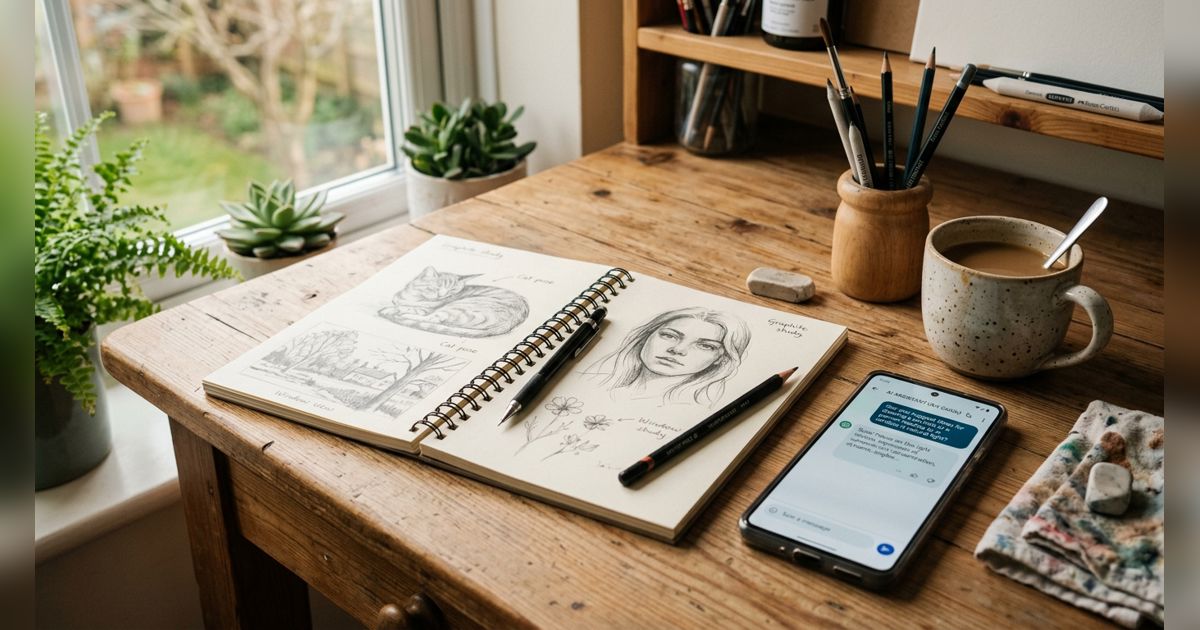
Struggling with drawing prompts? You're not alone. Every artist — whether you're a beginner with a sketchbook or a professional illustrator — knows how scary a blank page can feel. Traditional prompts like "draw a flower" often feel boring and uninspiring. That's where AI comes in. It makes the process much easier, sparks fresh creativity, and helps you create better drawings faster. In this guide, you'll find proven prompts that actually work — no more staring at a blank page wondering what to draw.
AI tools like ChatGPT, Claude, and even DALL-E aren't just for making images. They’re fantastic brainstorming partners that can create unlimited unique drawing prompts based on your style, mood, and skill level. Imagine having a creative coach available anytime you need it. No more spending hours on Pinterest or reusing the same old ideas. Just copy, paste, and let the AI surprise you. Ready to improve your drawing routine? Let's explore 20 powerful AI prompts that will generate excellent drawing ideas.
Why These AI Prompts Work
These prompts aren't random. They're written with clear instructions so the AI knows exactly what you want. Each one tells the AI the right tone, style, and details to use. This means you get practical, creative drawing prompts without constant editing. They save you hours of thinking, help you beat creative blocks, and push you to try new subjects and styles. Whether you draw with pencils, paint with watercolors, or work digitally, these prompts bring variety and fresh ideas. They've been tested and work well with any AI tool. Think of them as your personal weapon against artist's block.
Prompt #1: The 30-Second Warm-Up Blitz
You are a drawing teacher for busy professionals. Generate 8 ultra-fast drawing prompts that take 30 seconds or less each. Focus on simple shapes, lines, and gestures (e.g., "Draw 5 overlapping circles", "Sketch a zigzag that turns into a wave"). Tone: energetic and encouraging. Audience: adults with limited time. Output as a numbered list with a timer emoji before each prompt. Add at the top: "Set your phone timer for 30 seconds per prompt — go!"
Prompt #2: Character Fusion Lab
Act as a character designer for animated series. Create 6 drawing prompts that fuse two unrelated things: an animal + a vehicle, a fruit + a profession, a musical instrument + an insect. Example: "A pineapple as a detective with a tiny briefcase". Tone: playful and imaginative. Each prompt must include one unexpected detail (a hat, a scar, glasses). Output as bullet points with the fusion formula in parentheses.
Prompt #3: Emotional Weather Report
Imagine you are an art therapist helping people express feelings. Write 4 drawing prompts that represent emotions as weather phenomena. Example: "Draw anxiety as a thunderstorm approaching a small house". Each prompt must name a specific emotion (loneliness, excitement, confusion, peace) and a weather element (fog, lightning, rainbows, wind). Tone: gentle and poetic. Output as a numbered list with a short reflective question after each.
Prompt #4: Architecture from Another Planet
You are a concept artist for a sci-fi movie. Generate 5 drawing prompts for alien buildings that defy Earth's physics. Each prompt must specify: a strange material (living crystal, liquid metal, woven starlight), a purpose (temple, market, home), and a gravity condition (low gravity, zero gravity, shifting gravity). Tone: awe-inspiring and detailed. Output as a table with columns: Building Name, Material, Purpose, Gravity.
Prompt #5: Childhood Memory Remix
Act as a nostalgic illustrator. Create 3 drawing prompts that take a common childhood memory (birthday party, first bike ride, building a fort) and add one fantasy element (dragons, time travel, invisibility). Example: "Your 8th birthday party but every guest is a friendly monster". Tone: warm and whimsical. Output as short paragraphs with a sensory detail suggestion (smell, sound, texture) for each prompt.
Prompt #6: The Opposite Day Challenge
You are a creativity coach who loves paradoxes. Write 1 advanced drawing prompt with three parts. Part 1: "Draw a very heavy object that looks weightless." Part 2: "Draw a fast object that looks completely still." Part 3: "Draw a loud object that looks silent." Tone: challenging but playful. Output as a single block of text with each part on a new line. Add a note: "Don't overthink — just draw what comes first."
Prompt #7: Textures from the Kitchen
Imagine you are a still life artist who only draws food. Generate 5 drawing prompts focused on unusual textures found in a kitchen: cracked eggshells, torn lettuce, bread crust, melted cheese, coffee grounds. Each prompt must include a lighting instruction (backlit, side lit, candlelight) and a magnification level (actual size, 3x zoom, microscopic). Tone: curious and sensory. Output as bullet points with a texture adjective in bold.
Prompt #8: Mythological Creatures in Modern Jobs
Act as a satirical cartoonist. Create 4 drawing prompts where mythological creatures work everyday jobs. Examples: "A cyclops as an Uber driver struggling with depth perception", "A siren as a morning news anchor". Each prompt must include a visual gag or ironic twist. Tone: humorous and clever. Output as numbered list with a one-sentence setup before each prompt. Keep it family-friendly.
Prompt #9: One Line, Endless Possibilities
You are a minimalist drawing instructor. Write 6 prompts that start with a single continuous line. For each prompt, describe the starting line shape (spiral, zigzag, loop, wavy, angular, figure-eight) and ask the artist to turn it into something recognizable without lifting the pen. Example: "Draw a spiral. Now make it a snail, a galaxy, or a staircase." Tone: meditative and freeing. Output as a numbered list with a tiny sketch suggestion in brackets.
Prompt #10: Robots with Feelings
Imagine you are a sci-fi novelist exploring AI emotions. Create 5 drawing prompts for robots expressing complex human emotions: grief, jealousy, awe, nostalgia, embarrassment. Each prompt must specify a robot type (vintage tin toy, futuristic sleek bot, rusty industrial droid) and a body language cue (slumped shoulders, hidden face, extended hand). Tone: poignant and thought-provoking. Output as a bulleted list with the emotion as the heading.
Prompt #11: Hidden Worlds in Everyday Objects
Act as a children's book illustrator who loves secrets. Generate 4 drawing prompts that imagine tiny worlds inside ordinary things: inside a pencil sharpener, inside a coffee mug, inside a sneaker, inside a couch cushion. Each prompt must include 3 details about the tiny inhabitants (their clothes, homes, transportation). Tone: magical and intricate. Output as numbered paragraphs with a "what to draw first" instruction.
Prompt #12: Ink Wash Mood Board
You are a traditional ink painter. Write 3 drawing prompts that use only black ink and water (no color). Each prompt must focus on a specific technique: wet-on-wet for clouds, dry brush for rough textures, and line variation for movement. Examples: "Paint a forest fire using only dry brush", "Create a rainy window using wet washes". Tone: calm and instructional. Output as a numbered list with a technique tip in italics after each.
Prompt #13: Fashion for Imaginary Beings
Imagine you are a costume designer for a fantasy film. Create 5 drawing prompts for outfits worn by non-human characters: a mermaid's winter coat, a goblin's wedding dress, a dragon's battle armor, a fairy's rain gear, a yeti's swimsuit. Each prompt must include a fabric (scales, moss, clouds, stone, ice) and an accessory (goggles, crown, backpack, umbrella). Output as a table with columns: Character, Garment, Fabric, Accessory.
Prompt #14: The 10x10 Grid Challenge
Act as a drawing instructor for building habits. Generate 1 structured prompt: "Divide your page into a 10x10 grid (100 tiny squares). Set a timer for 10 minutes. In each square, draw a different tiny object — all from a single location (your desk, your kitchen, your garden). No square can be empty. Fill every single one." Tone: motivating and precise. Output as a short paragraph with a warning: "Don't worry about quality — quantity and speed win here."
Prompt #15: Dreams I Forgot I Had
You are a surrealist painter exploring the subconscious. Write 4 drawing prompts based on common dream fragments: flying but very slowly, teeth falling out, being chased by something kind, showing up naked somewhere important. Each prompt must ask the artist to add one impossible detail (talking furniture, gravity flipping, colors that make sounds). Tone: mysterious and inviting. Output as a numbered list with a one-sentence personal question after each ("Have you ever had this dream?").
Prompt #16: Hands in Unusual Positions
Imagine you are an anatomy teacher who hates boring hand studies. Create 6 drawing prompts for hands doing strange things: a hand holding water that won't spill, a hand turning into a tree branch, a hand made of smoke, a hand with eyes on each fingertip, a hand untying a knot that doesn't exist, a hand that's also a map. Tone: technically challenging but playful. Output as bullet points with a difficulty rating (easy, medium, hard) after each.
Prompt #17: Abandoned Places Reclaimed by Nature
Act as a concept artist for a post-apocalyptic video game. Generate 5 drawing prompts of abandoned human places being overtaken by plants, animals, and time: a library with trees growing through books, a submerged subway station with fish, a mall turned into a jungle, a gas station as a bird sanctuary, a school desk sprouting flowers. Each prompt must include a time indicator (10 years, 50 years, 100 years later). Output as numbered list with a color palette suggestion ("moss green, rust orange, concrete gray").
Prompt #18: Optical Illusions You Can Draw
You are an Op Art artist who loves confusing eyes. Write 4 drawing prompts for classic optical illusions that can be drawn with just a pencil and ruler: an impossible cube, a Penrose triangle, a twisting staircase, a figure-ground vase/faces illusion. Each prompt must include step-by-step instructions simplified into 3 bullet points. Tone: technical but encouraging.
Prompt #19: Expressions Without Faces
Imagine you are an animator who needs to show emotion using only body language and objects — no faces allowed. Create 5 drawing prompts that convey anger, fear, joy, disgust, and surprise using only hands, posture, and surrounding props. Example: "Show anger using only clenched fists and a shattered coffee cup." Each prompt must forbid any facial features (no eyes, mouths, or brows). Tone: challenging and creative. Output as a numbered list with a small sketch example in parentheses.
Prompt #20: Your Signature Style, Reinvented
Act as a personal art coach. Write 1 final, advanced prompt: "Look at your last 5 drawings. Identify one thing you always do (a specific eye shape, a way of drawing trees, a color you overuse). Now draw the exact opposite of that thing in every possible way. If you draw detailed eyes, draw abstract dots. If you draw realistic trees, draw geometric triangles. Break your own habit on purpose." Tone: reflective and bold. Output as a short paragraph with a challenge: "Post both versions side by side."
Frequently Asked Questions
What are AI writing prompts for drawing prompts?
AI writing prompts for drawing prompts are clear instructions you give to an AI tool to create custom drawing ideas. They work like a creative partner, helping you beat blocks and try new things without endless searching.
Can beginners use these AI drawing prompts?
Yes, absolutely. These prompts go from quick 30-second warm-ups to more detailed ones, so anyone can find something useful. Beginners should start with prompts #1, #5, or #9 to build confidence.
Which AI tool works best for generating drawing prompts?
ChatGPT, Claude, and Perplexity are all great for text prompts. For visual ideas, you can use Midjourney, DALL-E, or Stable Diffusion with the same prompts to get images for reference.
Are these prompts safe to share or sell online?
Yes. Every time you run them, the AI creates something original. You can safely share, post, or even sell the drawing prompts you generate without worrying about duplicates or copyright issues.
Conclusion
These 20 AI prompts give you a reliable way to never run out of drawing ideas — whether you draw for fun, teach art, or work professionally. Don’t just read this and forget it. Try one right now. Copy a prompt into ChatGPT, see what comes out, and start drawing. Feel free to change them however you like. Mix AI’s endless ideas with your own unique style. Your next favorite drawing might be just one prompt away. Now go create something amazing.
```